matt harvey art
Portrait paintings, art demonstrations, figurative painting, landscapes
Contrapposto thoughts
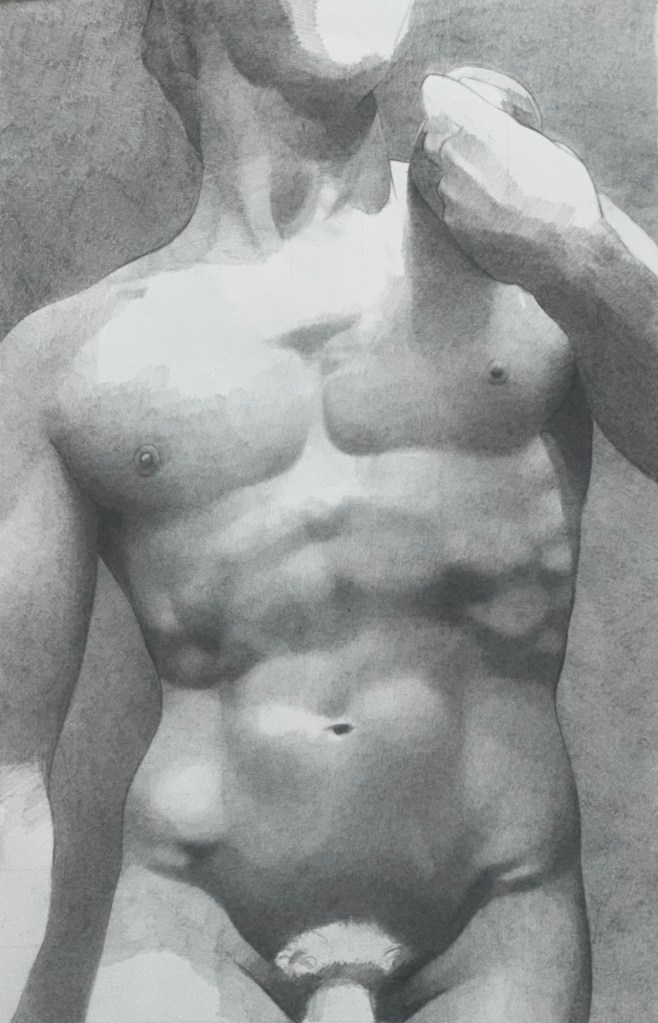
Discobolus has to be one of my favourite sculptures. What’s amazing is that the one I know is a Roman copy in stone of an original Greek bronze. To create it in bronze is one thing but to carve it in stone is a huge achievement. At art college I dismissed the great achievements of Hellenistic artists, simply going along with what was generally fashionable or the cool thing said at the time. Irrelevant, boring, not worth discussing, not worth consideration. I spent the first half of my life lacking the life force not to be influenced by my environment and the opinions of others, and it also took me a long time to get all of everyone else’s discourse out of my system.
Apart from life drawing and portraits I hardly worked from the figure for years and made a lot of non-figurative and abstract art. But one constant when I began working with the figure was a fascination with Contrapposto. This is also true of the non-figurative work I made. The aesthetic appeal is asymmetry. It’s recognisable even in my abstract or strictly speaking non-figurative work, because I was trying to make something that I had never seen before, but I think deep down the figure and Contrapposto were always there lurking in the background.
The philosophical idea underpinning Contrapposto is that the figure is self governing. Agency and power generate on the inside and are not determined by external forces. Discobolus is a collection of tension, poise, potential, a balance of opposites and asymmetry. This is a hallmark of life force: agency and self governance. For these Hellenistic artists Symmetry could imply an external ordering, in opposition to their philosophy of human agency in the world.
Symmetry is also beauty too though. If asymmetry is life perhaps symmetry aligns with the idea of death.
One of the most beautiful manifestations of symmetry in nature that I’ve seen is a hibernating queen wasp. She folds and closes her limbs exquisitely before falling into her deep sleep, perfectly aligned in a mini death like a sarcophagus. I hope you can see one one day I can’t find a good photo to show here.
Is symmetry closer to death and asymmetry to life? Life and death are two phases of the same continuum according to Buddhism. Both are beautiful, neither to be shunned.
The most beautiful art must surely show both symmetry and assymetry.
The Egyptian artist used symmetry to glorify the pharaohs, and Hellenistic artists developed asymmetric Contrapposto to glorify the idea of the divine human being; self-governing, rational and free. For the Egyptians symmetry reflected the eternal divine order of things. the pharaohs depicted were outside of time, gods on earth, guarantors of eternal stability against chaos.
Contrapposto for the Greek artist is internally generated power where humans can liberate themselves from their environments. The body as art can be a metaphor for this internal power. Asymmetry is a metaphor for life, intelligence, or life force. Symmetry is death, eternity, purity. Life and death are two sides of the same coin.
In my work this applies equally to bodies in motion or posed. It’s hard to say exactly what I’m looking for and I only know it when I see it. You’ll have to look at the work to see what I mean. But there must be some potential energy, some tension, not theatre.
 matt harvey art